

The Ultimate Guide to AV over IP: Benefits, Implementation, and Cost Analysis
In today’s fast-paced business world, effective communication is the backbone of success. Picture a scenario where your enterprise’s audio-visual systems work flawlessly, connecting teams across the globe with crystal-clear quality. This isn’t a pipe dream – it’s the reality that AV over IP brings to the table.
Audio-Visual over Internet Protocol (AV over IP) is revolutionizing how enterprises manage and distribute their audio and visual content. It’s not just an upgrade; it’s a complete transformation of the AV landscape. For forward-thinking enterprise organizations, understanding and implementing AV over IP isn’t just an option – it’s a strategic necessity.
In this comprehensive guide, we’ll dive deep into the world of AV over IP, exploring its benefits, implementation considerations, and cost analysis. Whether you’re a CTO looking to optimize your infrastructure or an IT manager seeking to enhance your organization’s communication capabilities, this guide is your roadmap to AV success.
Understanding AV over IP
At its core, AV over IP leverages your existing IT network to transmit high-quality audio and visual content. It’s the bridge between traditional AV systems and the digital future of enterprise communication.
 Definition and Core Concepts:
AV over IP refers to the transmission of audio-visual information via data packets over an Internet Protocol network. This approach replaces traditional, proprietary AV signal transmission methods with a more flexible, scalable solution.
How it Differs from Traditional AV Systems:
Unlike conventional AV setups that rely on dedicated hardware and point-to-point connections, AV over IP utilizes your existing network infrastructure. This shift brings unprecedented flexibility, scalability, and cost-efficiency to your AV operations.
Key Components of an AV over IP System:
1. Encoders: Convert AV signals into IP packets
2. Network Switches: Route the AV data across the network
3. Decoders: Convert IP packets back into AV signals
4. Control Systems: Manage and direct AV traffic
5. Endpoints: Displays, speakers, and other output devices
Benefits of AV over IP for Enterprises
Implementing AV over IP isn’t just about keeping up with technology trends; it’s about unlocking a host of advantages that can transform your enterprise’s communication infrastructure.
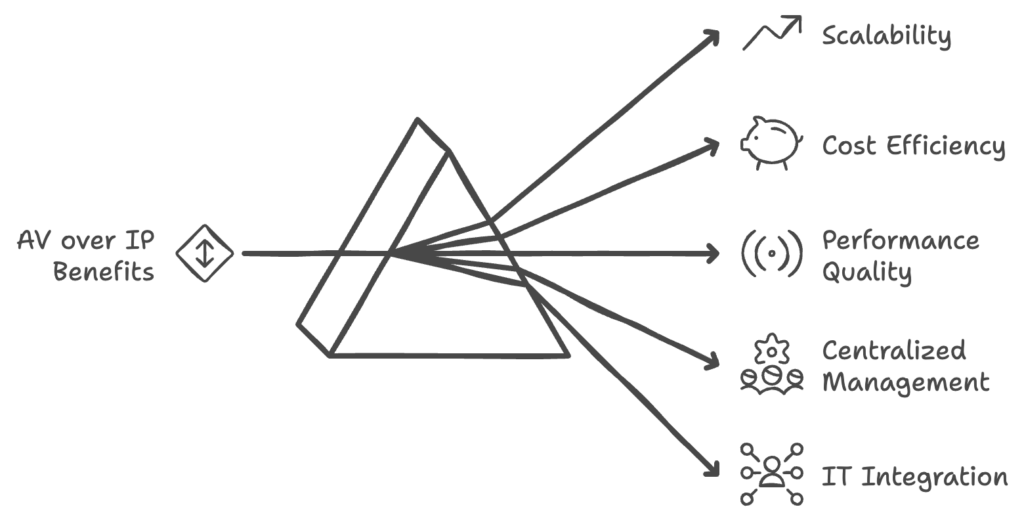 Scalability and Flexibility:
In the dynamic world of enterprise, adaptability is key. AV over IP systems shine in this regard, offering unparalleled scalability. Need to add a new conference room or expand to a new office? With AV over IP, it’s as simple as connecting to the network. This flexibility allows your AV infrastructure to grow and evolve with your business, without the need for extensive rewiring or hardware overhauls.
Cost Efficiency:
While the initial investment in AV over IP may seem substantial, the long-term cost savings are significant. By leveraging your existing IT network infrastructure, you eliminate the need for specialized AV cabling and reduce hardware costs. Moreover, the simplified maintenance and ability to centrally manage the system contribute to lower operational expenses over time.
Improved Performance and Quality:
Say goodbye to degraded signals and hello to consistently high-quality audio and video. AV over IP systems can deliver superior performance, especially over long distances. This is particularly beneficial for large enterprise campuses or organizations with multiple locations, ensuring that your teams always have crystal-clear communication, regardless of their physical location.
Centralized Management and Control:
One of the most compelling advantages of AV over IP is the ability to manage your entire AV ecosystem from a central location. This centralized control allows IT teams to monitor, troubleshoot, and update the system efficiently, reducing downtime and improving overall system reliability.
Integration with Existing IT Infrastructure:
AV over IP doesn’t require a separate, parallel network. Instead, it integrates seamlessly with your existing IT infrastructure. This integration not only simplifies management but also allows for more sophisticated applications, such as combining AV with data analytics or integrating with other enterprise systems for a truly connected workplace.
Implementation Considerations
While the benefits of AV over IP are clear, a successful implementation requires careful planning and consideration of several key factors:
Network Infrastructure Requirements:
Before diving into AV over IP, it’s crucial to assess your current network infrastructure. Can it handle the increased bandwidth demands? You may need to upgrade switches or increase network capacity to ensure smooth AV transmission without impacting other critical business operations.
Bandwidth and Latency Management:
AV traffic, especially high-quality video, can be bandwidth-intensive. Implementing Quality of Service (QoS) policies is essential to prioritize AV traffic and maintain performance, particularly in networks with mixed traffic types. Additionally, managing latency is crucial for applications like live video conferencing to ensure a seamless user experience.
Security Measures:
As with any IP-based system, security is paramount. Implementing robust security measures, including encryption, firewalls, and regular security audits, is essential to protect your AV content and prevent unauthorized access. Remember, your AV system is now part of your network, and it needs to be secured accordingly.
Interoperability and Standards:
To ensure long-term viability and flexibility, choose AV over IP solutions that adhere to industry standards. This approach will help maintain compatibility with existing equipment and future upgrades. Standards like SDVoE (Software Defined Video over Ethernet) are worth considering for their promise of interoperability and performance.
Quality of Service (QoS) Implementation:
Implementing effective QoS policies is crucial for maintaining high-quality AV performance, especially in networks with diverse traffic types. This ensures that your AV traffic receives the necessary priority and resources, even during peak network usage times.
Cost Analysis
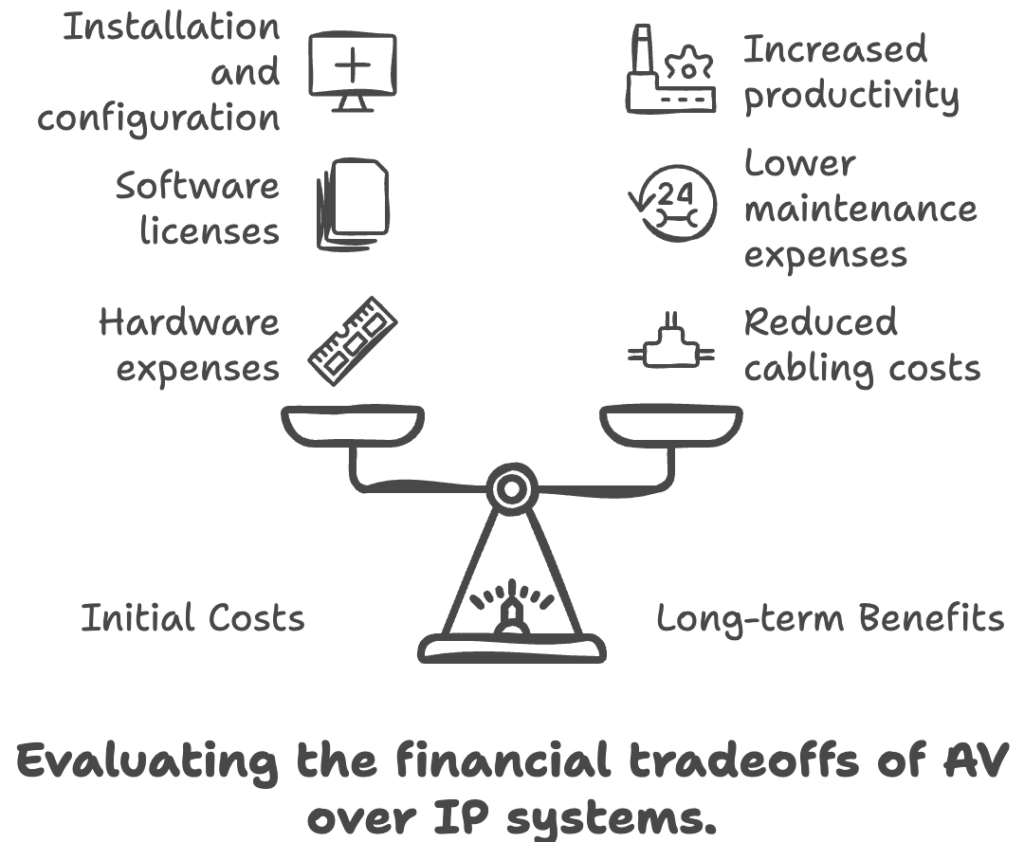
When considering the transition to AV over IP, a thorough cost analysis is crucial. While the initial investment may seem substantial, the long-term benefits often outweigh the costs.
Initial Investment:
– Hardware costs (encoders, decoders, network switches)
– Software licenses
– Installation and configuration
– Training for IT staff
Operational Costs:
– Maintenance and updates
– Energy consumption
– Network bandwidth allocation
Potential ROI:
– Reduced cabling and infrastructure costs
– Lower maintenance expenses
– Increased productivity through improved communication
– Scalability without significant additional costs
Long-term Savings:
Over time, AV over IP systems tend to be more cost-effective than traditional AV setups. The ability to use standard network infrastructure, centralized management, and easier scalability contribute to significant savings in the long run.
Case Study: Waterside District

To illustrate the real-world impact of AV over IP, let’s look at the Waterside District project in Norfolk, Virginia. This entertainment district faced the challenge of distributing high-quality audio and video content across multiple venues and outdoor spaces.
The Solution:
We implemented an AV over IP system using Crestron technology. This allowed for the seamless distribution of 4K video and audio across the entire district.
Key Outcomes:
– Flexible content distribution to over 200 displays
– Centralized control and management
– Scalability for future expansion
– High-quality audio and video performance in diverse environments
Waterside demonstrates how AV over IP can transform large-scale entertainment venues, providing flexibility, scalability, and high-quality AV distribution.
Comparison with Traditional Systems
To better understand the advantages of AV over IP, let’s compare it with traditional AV systems:
| Feature | Traditional AV | AV over IP |
|---|---|---|
| Scalability | Limited, requires new hardware and cabling | Highly scalable, uses existing network |
| Flexibility | Fixed point-to-point connections | Dynamic routing and configuration |
| Quality | Can degrade over long distances | Consistent quality, independent of distance |
| Management | Often decentralized | Centralized management and control |
| Cost | Higher long-term costs due to dedicated infrastructure | Lower long-term costs, leverages IT infrastructure |
| Integration | Limited integration with IT systems | Seamless integration with existing IT infrastructure |
Emerging Technologies and Future Trends
The world of AV over IP is constantly evolving. Here are some emerging technologies and trends to watch:
1. 8K Video Support: As display technology advances, AV over IP systems are adapting to support higher resolutions.
2. AI Integration: Artificial intelligence is being incorporated into AV systems for automated content optimization and predictive maintenance.
3. 5G Integration: The rollout of 5G networks will enable new possibilities for mobile AV over IP applications.
4. Cloud-Based AV Management: More AV systems are moving to cloud-based management for increased flexibility and remote access.
5. IoT Integration: AV over IP systems are becoming part of the broader Internet of Things ecosystem, enabling smarter, more connected environments.
Choosing the Right AV over IP Solution Provider
Selecting the right vendor is crucial for a successful AV over IP implementation. Consider the following criteria:
1. Expertise and Experience: Look for providers with a proven track record in enterprise AV over IP deployments.
2. Scalability: Ensure the solution can grow with your organization’s needs.
3. Interoperability: Choose solutions that work well with your existing infrastructure and adhere to industry standards.
4. Support and Training: Opt for vendors offering comprehensive support and training programs.
5. Security Features: Prioritize solutions with robust security measures built-in.
6. Cost-Effectiveness: Consider both upfront costs and long-term value.
Vicom would love to partner with your organization to design and implement the perfect solution and then work alongside you to support it in the future.
Implementation Roadmap
For enterprises looking to transition to AV over IP, here’s a step-by-step roadmap:
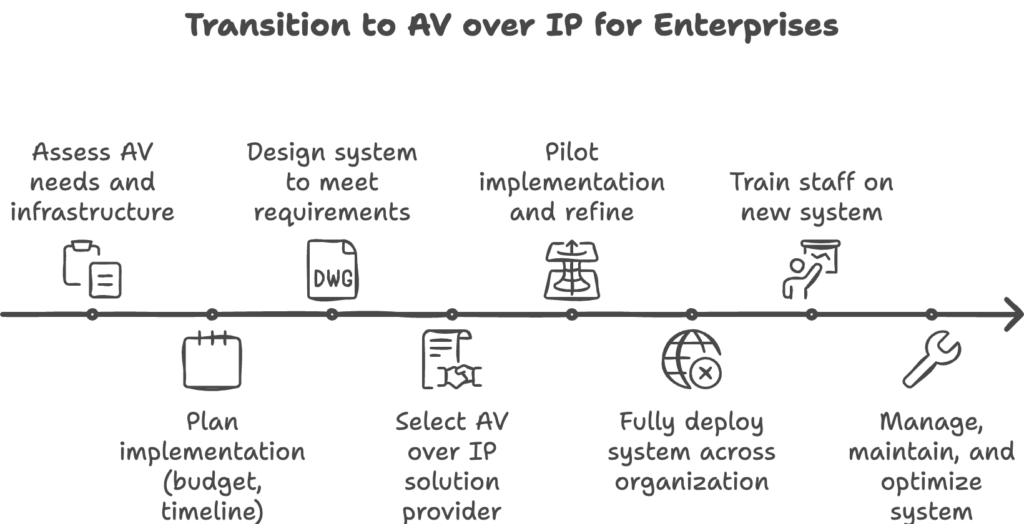
1. Assessment: Evaluate current AV needs and network infrastructure.
2. Planning: Develop a detailed implementation plan, including budget and timeline.
3. Design: Create a system design that meets your specific requirements.
4. Vendor Selection: Choose the right solution provider based on your needs.
5. Pilot Implementation: Start with a small-scale deployment to test and refine.
6. Full Deployment: Roll out the system across your organization.
7. Training: Ensure all relevant staff are trained on the new system.
8. Ongoing Management: Continuously monitor, maintain, and optimize the system.
Regulatory Compliance
When implementing AV over IP, consider relevant regulatory requirements, especially in industries with strict data protection rules:
– GDPR: For organizations dealing with EU data, ensure AV systems comply with GDPR requirements.
– HIPAA: Healthcare organizations must ensure AV over IP systems meet HIPAA standards for patient privacy.
– SOC 2: Consider SOC 2 compliance for AV systems handling sensitive information.
Supporting Remote and Hybrid Work
AV over IP is particularly valuable in today’s remote and hybrid work environments:
– Enhanced Collaboration: High-quality video conferencing and content sharing improve remote team collaboration.
– Flexibility: Easily adapt AV setups to changing office configurations and remote work needs.
– Consistent Experience: Provide the same high-quality AV experience for in-office and remote workers.
– Scalability: Quickly scale AV capabilities to support fluctuating numbers of remote and in-office workers.
Let’s wrap up!
As we’ve explored throughout this guide, AV over IP represents a significant leap forward in enterprise communication technology. It’s not just an upgrade to existing systems; it’s a complete paradigm shift that aligns audio-visual capabilities with modern IT infrastructure.
For enterprise organizations looking to stay competitive in an increasingly digital world, embracing AV over IP is not just a technological decision – it’s a strategic imperative. By leveraging this technology, businesses can create more dynamic, responsive, and connected workspaces that foster innovation and drive success.
As you consider your organization’s AV strategy, remember that the transition to AV over IP is a journey. It requires careful planning, expertise, and a clear vision of your communication goals. But with the right approach and partners, it’s a journey that can transform your enterprise’s ability to connect, collaborate, and compete in the modern business landscape.
The future of enterprise AV is here, and it’s IP-based. Are you ready to take the leap?
FAQs
1. How does AV over IP differ from traditional AV systems?
AV over IP uses standard IP networks to transmit audio and video, unlike traditional systems that use dedicated AV cables and hardware.
2. What are the main benefits of implementing AV over IP in an enterprise setting?
Key benefits include scalability, cost-efficiency, improved performance, and centralized management.
3. Is AV over IP secure?
With proper implementation of security measures like encryption and firewalls, AV over IP can be very secure.
4. How does AV over IP impact network bandwidth?
AV over IP can be bandwidth-intensive, especially for high-quality video. Proper network planning and QoS implementation are crucial.
5. What should I consider when choosing an AV over IP solution?
Consider factors such as scalability needs, compatibility with existing infrastructure, video quality requirements, security features, and management options.
6. How does AV over IP support 4K and 8K video transmission?
AV over IP systems use advanced compression technologies and high-bandwidth networks to support 4K and 8K video transmission efficiently.
7. What network infrastructure upgrades might be necessary for AV over IP?
Depending on your current setup, you might need to upgrade to 10Gb switches, increase bandwidth, or implement QoS policies.
8. How does AV over IP integrate with unified communications platforms?
Many AV over IP solutions offer APIs or direct integrations with popular UC platforms, enabling seamless communication across various tools.
9. What are the typical latency expectations for AV over IP systems?
Modern AV over IP systems can achieve latencies as low as 1ms, though this can vary based on network conditions and specific implementations.
10. How does AV over IP support BYOD (Bring Your Own Device) policies in the workplace?
AV over IP systems often include features for easy device connectivity and wireless content sharing, supporting BYOD initiatives.